


S&P Global warns that a prolonged war could accelerate the cooling cycle in Dubai real estate
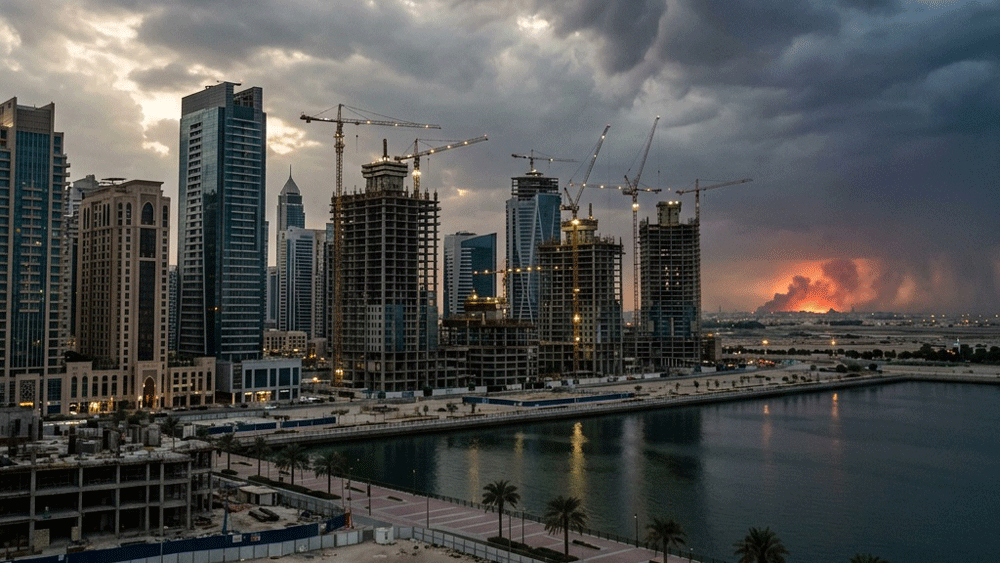
The outbreak of the Iran-US-Israel war has injected a powerful dose of uncertainty into Dubai’s residential real estate market, a sector already bracing for a cyclical cooldown.
A new report from S&P Global Ratings, published on 16 March, outlines the parameters of the risk.

The core argument is that while Dubai is not facing an immediate 2008-style collapse, the market’s resilience is now a function of time. If the conflict intensifies beyond a one-month horizon, the strains on prices, investor confidence and developer balance sheets could become severe.
Momentum stalls as caution takes hold
The most immediate impact of the conflict has been psychological. According to S&P, official sources are already reporting lower transaction volumes since the war began. The prolonged war could mark the end of the post-pandemic boom, shifting the market into a phase of guarded caution.
The luxury segment, which has driven much of the recent growth, is seen as the most vulnerable. High-net-worth individuals who relocated to Dubai for its perceived safety and tax advantages may now reconsider their positions, given that the city’s ‘safe haven’ status is being tested.
S&P’s baseline forecast assumes the most intense phase of fighting will last up to four weeks. Under this scenario, the market will likely experience a slowdown in both volumes and prices, with the declines being more pronounced the longer the uncertainty drags on.
The report notes a flight to liquidity, predicting that secondary market transactions will become more prevalent as investors seek to offload properties, further suppressing values.
Apartments are expected to suffer steeper price drops than villas due to a robust supply pipeline.
Regulatory shields and the threat of a prolonged conflict
One of the central tenets of the report is that Dubai’s post-2008 regulatory framework provides a crucial buffer. Escrow accounts and stringent payment plans mean that for projects already under way, developers should be able to complete construction, barring a wave of mass investor defaults.
The rules offer significant protection: developers can retain up to 40% of the property value if construction is on schedule, refund the remainder, and repossess the unit for resale.
However, this protection has limits. S&P warns that a prolonged war scenario would test these regulations. If the Strait of Hormuz remains closed, supply chains for construction materials could bottleneck, driving up input costs. More critically, the rules that protect developers would only be effective up to a point.
In a deep and lasting downturn, project cancellations would become likely, particularly for newly launched developments that have not secured substantial presales.
The analysis suggests that while top-tier developers weathered past downturns with delinquency rates of just 3-10%, the figure for newer, less experienced players could be much higher.
Rated developers have headroom, but it is not infinite
The four major developers rated by S&P with exposure to Dubai are Emaar Properties, Damac Properties, PNC Investments and Omniyat Holdings. All of these players enter the period of uncertainty from a position of relative strength.
The report highlights that years of strong sales have created significant revenue backlogs covering several years.
Emaar leads with the revenue backlog of about $37bn, equivalent to 2.7 years, while Damac holds about $22bn of backlog, representing 2.3 years.
Their leverage is low, and cash positions are meaningful. As of 31 December 2025, Emaar held $7.5bn in cash and liquid investments, with $11.7bn as escrow cash balance.
Damac holds $1.7bn in total cash, including $6bn in escrow, while PNCI and Omniyat hold more modest balances of $600m and $600m, respectively.
S&P has built “substantial headroom” into their credit ratings to absorb sudden shocks.
The liquidity assessments for all four companies are adequate, with manageable debt maturities in 2026.
The critical question is duration. If the conflict grinds on, the buffers will narrow.
S&P states that in a prolonged scenario, its reassessment will focus on construction progress, cash collection and working capital.
The financial policies of management teams, specifically their willingness to maintain low leverage and cut dividends, will be key to preserving creditworthiness.
Capex and dividends under review
The war will also force a recalibration of corporate strategy. The report notes that investment decisions are likely to be postponed or cancelled. While commitments for projects nearing completion will proceed, companies will prioritise liquidity over new land purchases.
This is most pronounced for Emaar, which has sizeable capital expenditure plans of AED10bn-AED11bn ($2.7bn-$3bn) annually in 2026-27 for projects such as Dubai Creek Tower, Dubai Creek Mall and the expansion of Dubai Mall. S&P believes a significant portion of this spending is flexible and can be delayed if needed.
Dividend policies will also be tested. The report expects dividend distributions to remain substantial but potentially adjustable.
S&P’s analysis paints a picture of a market that is braced for impact but not yet broken. The fundamentals are stronger than they were in 2008, thanks to tighter regulations and well-capitalised developers with $10bn in combined cash reserves.
However, the market’s fate is now externally determined. If the conflict remains contained and short-lived, Dubai’s real estate sector should absorb the shock with manageable declines.
But if the war becomes a protracted regional crisis, the meaningful correction that S&P flags as a possibility will move from the realm of the theoretical to the probable, testing the resilience of both the developers and the regulatory framework designed to protect them.
You might also like...

UAE bank asset quality hinges on property market
03 April 2026

Safety and security matters
03 April 2026


Saudi forecast remains one of growth
03 April 2026

A MEED Subscription...
Subscribe or upgrade your current MEED.com package to support your strategic planning with the MENA region’s best source of business information. Proceed to our online shop below to find out more about the features in each package.
Take advantage of our introductory offers below for new subscribers and purchase your access today! If you are an existing client, please reach out to your account manager.